Imagine your product as a net, designed to hold onto customers throughout their journey. But like any net, gaps can form—moments where users feel overlooked, frustrated, or disconnected. These experience gaps can lead to churn, missed opportunities, and broken trust.
In my last article, 'Why Speed Alone Isn't Enough', I shared how we used Compassionate Macros to scale support without losing the human touch. But customer conversations aren't the only place where empathy matters.
Every part of your product—from onboarding to system messages—shapes how users feel. The challenge? Automation at scale often strips away warmth, leaving interactions feeling transactional or impersonal.
So how do you ensure your product doesn't just function well but also feels human?
It comes down to embedding empathy into every automated touchpoint—from micro-celebrations to gentle nudges to UI messages.
Empathy Isn't Just Nice—It's a Strategic Advantage
Empathy isn't just a "nice to have"—it's a competitive advantage. The numbers prove it:
- 📊 73% of companies with above-average customer experience outperform their competitors financially. (Temkin Group)
- 📊 Brands that build emotional connections grow sales 85% faster than those that don't. (Gartner)
- 📊 Customers are 4.8x more likely to buy from brands they trust. (PwC)
The takeaway? Thoughtful, human-centered interactions don't just improve customer experience—they drive revenue, loyalty, and long-term growth.
But here's the challenge: As brands scale and automate more interactions, they risk creating experiences that feel robotic or impersonal. The key isn't to replace human connection with automation—but to design automation that amplifies empathy.
Bringing Empathy Back: Three Essential Touchpoints
So, how do you bring empathy back into automated experiences? By focusing on the moments that matter.
Three types of empathy-driven touchpoints can transform automation from cold and transactional to warm and human:
- ✅ Micro-Celebrations – Recognizing customer progress to reinforce engagement
- ✅ Gentle Nudges – Encouraging action without pressure or robotic messaging
- ✅ Embedded Empathy – Weaving care into UI & system messages
When done right, these touchpoints don't just make automation feel more human—they make it more effective.
1. Micro-Celebrations: Turning Small Wins Into Lasting Engagement
Empathy isn't just about solving problems—it's about celebrating progress. Micro-celebrations acknowledge customer milestones, reinforcing momentum and engagement. When users feel recognized early, they're more likely to stay engaged.
At Inbox2Action, we've applied this approach to onboarding, ensuring users feel seen and supported from their very first steps.
Example: An Event-Triggered Celebration Message
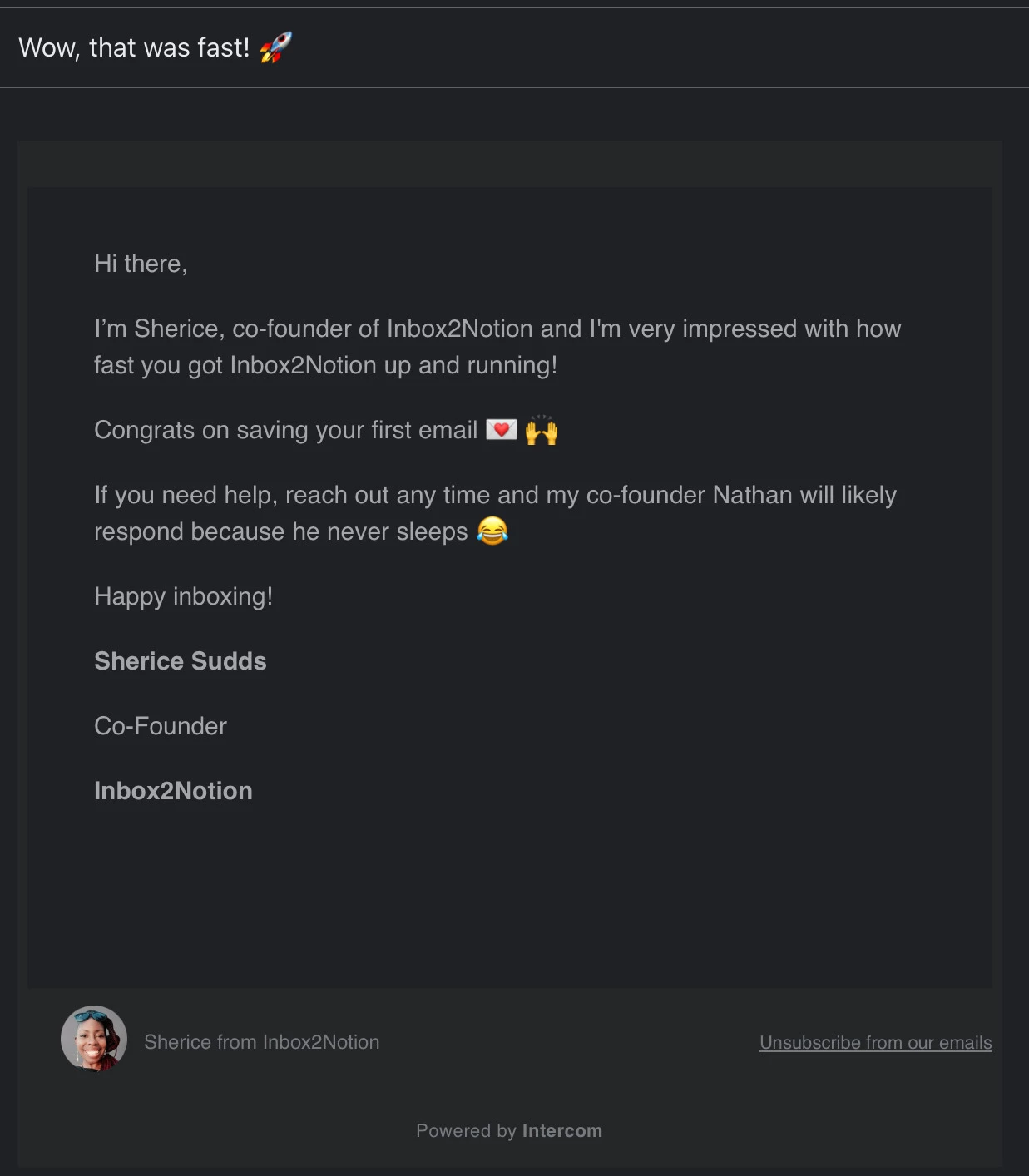
When a user saves their first email into Notion using Inbox2Action—within the first two days—we recognize that momentum with a personal touch. Since this email is triggered by their action (not just a generic onboarding sequence), it feels timely and relevant.
Subject: Wow, that was fast! 🚀
"Hi [User's First Name], I'm Sherice, co-founder of Inbox2Action, and I'm really impressed with how fast you got set up! 🎉 Congrats on saving your first email! 📩🙌 If you need help, reach out anytime—Nathan (my co-founder) will probably respond immediately because he never sleeps. 😂"
This isn't just a friendly touchpoint—it's a strategic moment that does three things:
- ✅ Acknowledges progress – Their first email isn't just an action; it's a milestone.
- ✅ Creates connection – The message feels warm and personal, reinforcing that they're supported.
- ✅ Encourages continued engagement – By recognizing their initiative, we reinforce their momentum and subtly guide them toward deeper engagement.
📌 How to Apply This with Intercom
Use Intercom's event-based triggers to send messages based on real user actions, rather than just time-based sequences. Instead of a generic "Here's what we offer" email, set up triggers that respond to:
- Key milestones (e.g., first action taken, first feature used)
- Signs of momentum (e.g., completing multiple actions quickly)
- Behaviors that predict long-term engagement
By celebrating small wins at the exact right moment, you're not just making users feel good—you're reinforcing the behaviors that lead to retention and long-term engagement.
2. Gentle Nudges: Encouraging Action Without Pressure
While micro-celebrations reward engagement, gentle nudges help when engagement drops. These touchpoints encourage action—like exploring a feature or renewing a subscription—without feeling pushy or transactional.
Example: When Nudges Go Wrong
During my time in customer experience at a startup, I saw firsthand how automation can either support or alienate customers. One moment, in particular, stuck with me.
A nurse who relied on the service for accountability shared how an automated email about a missed session completely changed her perception of the product. After an exhausting shift, she received what was meant to be a helpful reminder—but instead, it felt like a reprimand. Rather than feeling supported, she felt criticized—and she questioned whether the service was worth keeping.
💡 How to Make Nudges Feel Supportive, Not Pushy
✅ Reframe the message with empathy. Instead of:
"You missed your session today."
Try:
"We missed you today! Life gets busy—here's a quick way to reschedule when you're ready."
✅ Every interaction is a trust-building 'deposit' or 'withdrawal.' A poorly worded or untimely message can do more harm than good.
Example: Tracking Events to Send Smart Nudges
At Inbox2Action, we use PostHog's integration with Intercom to track key customer actions—like saving their first email to Notion or hitting a milestone.
By setting up event-based triggers, Intercom can automatically send behavior-driven nudges. For example:
🔹 If a user repeatedly clicks "Sync," but nothing happens, this could signal frustration — prompting a proactive support message.
🔹 If a user tries to access a gated feature multiple times. → It may indicate strong interest —making it the perfect moment for a timely upgrade offer.
🔹 If a user begins inviting teammates but stops before sending an invite. → A simple, well-placed message could encourage follow-through:
"Thinking about inviting a teammate? Here's why it makes collaboration easier!"
📌 How to Apply This with Intercom
Use Product Analytics to trigger behavior-based nudges in Intercom, making outreach feel more human and relevant.
🚀 Don't have events set up in Intercom? Product analytics tools like PostHog can track key moments and some allow you to pass them to Intercom without extra development—so you can trigger smart nudges at the right time.
3. Embedded Empathy: Weaving Care Into UI & System Messages
Not all empathy-driven touchpoints are triggered by an action. Some are baked into the product itself—through UI elements like modals, tooltips, and system messages.
A single line of UI copy can completely change how a customer experiences your product. Thoughtful wording makes an interface feel human, while cold, robotic messages can make even a great product feel frustrating or impersonal.
Example 1: The Power of Thoughtful UI Copy in a Critical Moment
Few things are more frustrating than a failed payment attempt—it can trigger anxiety, confusion, or even cause a user to churn.
Compare these two payment failure messages:
❌ Cold & Unhelpful:
"Payment failed. Please update your billing information to continue using the service."
✅ Empathetic & Supportive: (Actual email from Inbox2Notion)
Subject: Oops… We Couldn't Process Your Payment 😅 🥲
"Hi [User's First Name], Oops! It looks like we had a little trouble processing your payment for your Inbox2Action subscription. No worries, these things happen! To keep your account active and avoid any interruptions, simply update your billing information. It's quick and easy, we promise! 👉 [Update Billing Information] If you need any help or have questions, just reply to this email or visit our help center. We're here for you! Thank you for being a part of the Inbox2Notion community. Nathan, Sherice & the Inbox2Notion Team"
Why This Works
- ✅ Acknowledges the situation without blame – "No worries, these things happen!" reduces stress.
- ✅ Keeps the tone friendly and supportive – Instead of making the user feel like they did something wrong, it reassures them.
- ✅ Offers a clear next step – A prominent button makes it easy to fix the issue.
- ✅ Leaves the door open for help – Users can reply or visit the help center instead of feeling stuck.
Example 2: A Missed Opportunity for Embedded Empathy
At Inbox2Action, we display a loading screen when users sync emails between Gmail and Notion. Right now, it says:
❌ "Please wait, this may take a few moments."
❌ "🔄 Syncing…"
This message is functional, but it doesn't acknowledge the user's experience. A small wording change could make it feel warmer and more reassuring:
✅ "Hang tight! We're getting everything synced for you. 🚀" (Adds warmth and energy)
✅ "Syncing your email with Notion—this won't take long!" (Clarifies what's happening)
✅ "This usually takes just a few seconds, but we'll let you know if it needs more time!" (Sets expectations)
This is something we're actively thinking about in our own product. It's a great example of how small wording choices shape the user experience—and how embedded empathy is an ongoing process.
📌 How to Apply This in Your Product
- ✅ Audit your UI copy – Look for payment failures, loading screens, error messages, and confirmations. Are they clear, warm, and supportive?
- ✅ Add small reassurances – Words like "We've got you" or "Almost there!" can make a big difference. Try finding a phrase that feels natural and fits your brand's personality—whether that's warm and friendly, professional and direct, or playful and fun.
- ✅ Test different messages – Try A/B testing different UI messages to see what resonates best with users.
Bringing It All Together
Empathy shouldn't be an afterthought—it should be woven into every touchpoint. The best products don't just fix issues reactively; they build emotional connection proactively. Every small moment—a message, a nudge, an acknowledgment—is a chance to reinforce trust and loyalty.
📌 Try This Out:
- 🚀 Find one moment in your product where a Micro-Celebration could reinforce engagement.
- 🔍 Review your Gentle Nudges—do they feel supportive or transactional?
- 🛠 Test an Embedded Empathy message and see if it improves user behavior.
By designing for empathy, you're not just improving customer experience—you're creating a product people remember and trust.
Back to all articles